
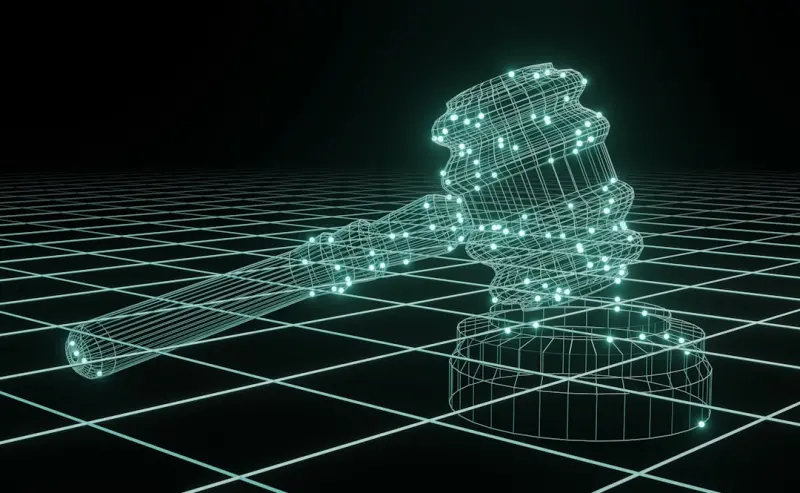
The Digital Frontier: How Technology Is Redefining Criminal Law
When I first walked into a courtroom, the biggest tech I saw was a clunky tape recorder. Today, the very walls of the courtroom are lined with screens that can replay a suspect’s entire digital life in seconds. Smartphones, smart homes, and even smart watches are now treasure troves for prosecutors looking to paint a narrative of guilt before a single witness takes the stand. The speed at which data flows from a social platform to a police database feels like a double‑edged sword—empowering victims while simultaneously threatening the presumption of innocence. As a defense attorney, I’ve learned that the real battle is no longer about who committed the act, but about who controls the story that data tells. The challenge is to keep the human element alive in a world that increasingly trusts algorithms more than intuition.
From Likes to Leverage: Social Media as Evidence
It’s no longer enough for the prosecution to prove a motive; they now mine every “like,” “share,” and comment to construct a motive that feels almost cinematic. A single tweet can become the centerpiece of a case, and a fleeting Instagram story can be amplified into “proof” of intent. In my practice, I’ve seen jurors stare at screenshots projected on a screen, treating them as if they were forensic fingerprints. The social media evidence playbook has become a staple in every courtroom briefing, and yet the line between public expression and incriminating evidence remains blurry. Defending a client now means mastering the art of digital forensics, challenging the authenticity of a post, and questioning whether the context was preserved when the content was captured. It’s a delicate dance—one that demands both legal acumen and a deep understanding of the platforms that shape modern discourse.
AI‑Powered Facial Recognition: Seeing Justice or Seeing Bias?
Facial recognition software promises to match a suspect’s face to a database with near‑perfect accuracy, but the technology is still riddled with systemic biases. Studies show higher error rates for people of color, women, and younger individuals, yet courts continue to admit these matches as decisive evidence. The algorithmic opacity creates a scenario where a defendant may be convicted based on a faulty line of code rather than tangible proof. As an attorney, I’m forced to call upon independent experts to dissect the underlying datasets, reveal sampling errors, and expose the lack of transparency that plagues many commercial systems. The courtroom, once a venue for human testimony, now feels like a stage for silicon-driven assertions. This shift raises profound questions: should a machine’s “certainty” outweigh a human’s right to a fair trial?
Predictive Policing: The Future That Already Exists
Predictive policing tools analyze historical crime data to forecast where future offenses might occur, guiding patrols and resource allocation. While the intention is to prevent crime, the reality often amplifies existing disparities. Neighborhoods already over‑policed become even more saturated with law enforcement, leading to a feedback loop that inflates crime statistics and justifies further surveillance. For defendants, this means being arrested not because they committed a crime, but because an algorithm flagged their location as a “hot spot.” The ethical quandary lies in the fact that the data feeding these models is itself a product of biased policing practices. Defending someone caught in this net requires challenging not just the immediate charge, but the very methodology that led to the stop. It’s a battle against a system that claims to be data‑driven while hiding the human prejudice embedded in its core.
courtroom Challenges: When Algorithms Take the Stand
The introduction of algorithmic evidence forces lawyers to confront a new kind of expert witness—a data scientist rather than a forensic analyst. The courtroom must now grapple with questions of reproducibility, validation, and error margins that were once confined to laboratories. I often find myself asking, “Can the prosecution disclose the source code?” and “What is the false‑positive rate for this model?” These queries are not merely academic; they directly impact the weight a judge or jury assigns to the evidence. Moreover, the legal community is still developing standards for admissibility, leaving many decisions to the discretion of individual judges. This variability can result in uneven outcomes, where a technically sound algorithm is dismissed in one jurisdiction but accepted in another. The stakes are high, and the need for clear, consistent guidelines has never been more urgent.
Preserving Rights in a Data‑Driven World
Our Constitution enshrines the right to remain silent, yet the digital age has introduced a plethora of ways to speak without uttering a word. Geolocation data, voice assistants, and even the rhythm of a person’s typing can be interpreted as “speech” by modern prosecutors. The Fourth Amendment protections against unreasonable searches now extend to digital devices, but courts are still wrestling with what constitutes a reasonable expectation of privacy in a cloud‑centric environment. I counsel clients to take proactive steps: encrypting communications, disabling location services, and understanding the legal ramifications of consenting to data collection. At the same time, I advocate for legislative reforms that clearly define the boundaries of digital searches, ensuring that law enforcement cannot sidestep constitutional safeguards simply by tapping into a server.
Defense Strategies: Turning Technology Against Itself
When the prosecution leans heavily on digital evidence, the defense can often turn that same technology into a weapon of truth. By commissioning independent audits of forensic software, we can expose inconsistencies and highlight potential tampering. In cases involving social media, we scrutinize metadata to determine whether a post was edited, scheduled, or even fabricated using bots. Additionally, the rise of deepfake detection tools—originally designed to combat misinformation—offers a new avenue to challenge manipulated video or audio recordings. These tactics require a multidisciplinary team, blending legal expertise with cybersecurity, data science, and even psychology. The goal is to remind the judge and jury that a polished digital narrative does not automatically equate to factual accuracy.
The Road Ahead: Balancing Innovation with Justice
Technology will continue to infiltrate every facet of criminal law, from investigation to adjudication. As we stand at this crossroads, the legal profession must decide whether to become passive recipients of tech trends or active architects of a fairer system. This means advocating for transparent algorithms, demanding rigorous standards for digital evidence, and educating jurors about the limitations of AI. It also means preserving the human touch that ensures empathy, context, and nuance are not lost in a sea of data points. In my experience, the most compelling defense stories are still those that highlight the humanity behind the numbers. By championing both innovation and integrity, we can safeguard the core principle that every individual is presumed innocent until proven guilty—no matter how many pixels point their way.

Kris Kennel is a Paralegal outside of Austin, Texas where he spends most of his time helping users with legal matters that concern them. When he is not working he enjoys time with his wife and kids.
Related Posts

Ransomware’s Legal Revolution: How Criminal Law Is Catching Up
Ransomware has moved from a niche threat to a global crisis, forcing criminal law to evolve. This ar... Read More

Predictive Policing: Constitutional Risks and Defense Strategies
A deep dive into the constitutional pitfalls of predictive policing, offering practical defense stra... Read More

Restorative Justice and Therapeutic Courts: A New Path for Criminal Law
A fresh look at restorative justice and therapeutic courts reveals how community‑based solutions, ... Read More
Top Posts
Cross‑State Tax Strategies for Remote‑First SaaS Teams
Remote work has turned tax compliance into a multi‑state maze for SaaS companies. This guide walks executives through nexus risks, payroll and sales tax chall...Read More
Digital Service Taxes: What Every B2B SaaS Company Must Know
Digital Service Taxes are reshaping the SaaS landscape. This guide walks B2B SaaS leaders through the new tax regime, from identifying taxable services to build...Read More

Navigating Marriage Law in the Digital Age: Challenges, Tech, and Tomorrow
Discover how tech transforms marriage law—from crypto assets to AI‑driven courts—and get actionable insights for couples navigating the digital era....Read More
Uncovering Hidden Tax Opportunities in Startup Employee Stock Options
Discover actionable tax strategies for startup employees to turn stock options into lasting wealth, covering ISOs, NSOs, AMT, and more....Read More
0 Comments
Post Comment
You will need to Login or Register to comment on this post!